Prenestina 913
Rome, Italy - 2022

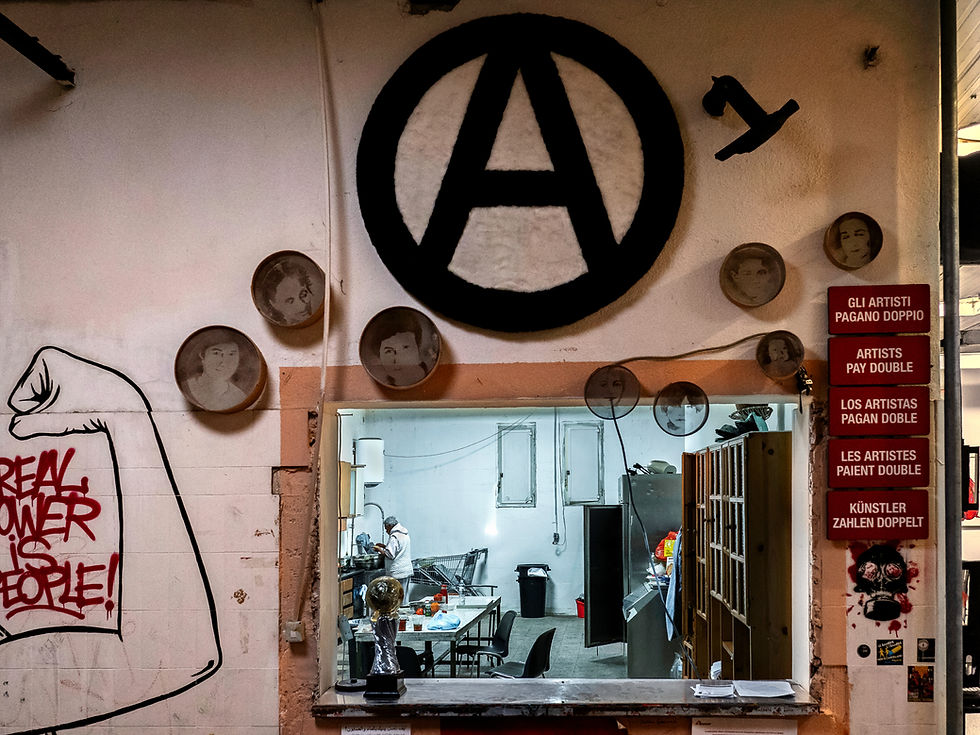
Facade of the former factory, now the entrance to the MAAM.
Facade of the former factory, now the entrance to the MAAM.
The practical value of art has often been debated, especially in the modern era, where we tend to assign a utilitarian function to everything.
Yet, in Rome, there is a place where art has produced a direct and tangible impact on the life of a community.
This place is MAAM — Museo dell’Altro e dell’Altrove di Metropoliz. Located in Via Prenestina 913, inside a former slaughterhouse in the eastern industrial outskirts of the city, MAAM hosts more than four hundred artworks created by Italian and international artists. Sculptures, murals and conceptual installations inhabit the space, transforming it into a living archive of contemporary art.
What makes MAAM unique, however, is that it is not only a museum. It is an inhabited place. Around two hundred people of different nationalities live inside the structure, sharing common spaces, daily routines and responsibilities. Art and life coexist here, shaping each other continuously.

View of the former factory’s perimeter from the outside.
View of the former factory’s perimeter from the outside.

Street art installations at the MAAM.
Street art installations at the MAAM.

Street art installations at the MAAM.
Street art installations at the MAAM.

Street art installations at the MAAM.
Street art installations at the MAAM.

Street art installations at the MAAM.
Street art installations at the MAAM.

Street art installations at the MAAM.
Street art installations at the MAAM.
MAAM was born in March 2009, when the collective “Blocchi Precari Metropolitani” occupied the abandoned slaughterhouse to provide housing to homeless families.
Over time, the occupation evolved into an artistic and political project, transforming the building into a shared space where cultural production and everyday life became inseparable.

Resident of Metropoliz, the residential complex created inside the former factory.
Resident of Metropoliz, the residential complex created inside the former factory.

Resident of Metropoliz, the residential complex created inside the former factory.
Resident of Metropoliz, the residential complex created inside the former factory.

Resident of Metropoliz, the residential complex created inside the former factory.
Resident of Metropoliz, the residential complex created inside the former factory.

Resident of Metropoliz, the residential complex created inside the former factory.
Resident of Metropoliz, the residential complex created inside the former factory.

Resident of Metropoliz, the residential complex created inside the former factory.
Resident of Metropoliz, the residential complex created inside the former factory.

Resident of Metropoliz, the residential complex created inside the former factory.
Resident of Metropoliz, the residential complex created inside the former factory.

Resident of Metropoliz, the residential complex created inside the former factory.
Resident of Metropoliz, the residential complex created inside the former factory.

Resident of Metropoliz, the residential complex created inside the former factory.
Resident of Metropoliz, the residential complex created inside the former factory.
Living inside MAAM means taking care not only of one’s own domestic space, but also of the museum itself.
The inhabitants are responsible for the maintenance of the building, the preservation of the artworks and the organization of visits.
Daily life and cultural heritage overlap continuously.

Residents are responsible for the museum’s upkeep, including cleaning, artwork care, and visit organization.
Residents are responsible for the museum’s upkeep, including cleaning, artwork care, and visit organization.

Residents are responsible for the museum’s upkeep, including cleaning, artwork care, and visit organization.
Residents are responsible for the museum’s upkeep, including cleaning, artwork care, and visit organization.

Residents are responsible for the museum’s upkeep, including cleaning, artwork care, and visit organization.
Residents are responsible for the museum’s upkeep, including cleaning, artwork care, and visit organization.

Residents are responsible for the museum’s upkeep, including cleaning, artwork care, and visit organization.
Residents are responsible for the museum’s upkeep, including cleaning, artwork care, and visit organization.

Residents are responsible for the museum’s upkeep, including cleaning, artwork care, and visit organization.
Residents are responsible for the museum’s upkeep, including cleaning, artwork care, and visit organization.

Residents are responsible for the museum’s upkeep, including cleaning, artwork care, and visit organization.
Residents are responsible for the museum’s upkeep, including cleaning, artwork care, and visit organization.

Residents take care of the museum’s upkeep and provide a home-cooked meal after the visit.
Residents take care of the museum’s upkeep and provide a home-cooked meal after the visit.

Residents take care of the museum’s upkeep and provide a home-cooked meal after the visit.
Residents take care of the museum’s upkeep and provide a home-cooked meal after the visit.

Residents take care of the museum’s upkeep and provide a home-cooked meal after the visit.
Residents take care of the museum’s upkeep and provide a home-cooked meal after the visit.

Residents take care of the museum’s upkeep and provide a home-cooked meal after the visit.
Residents take care of the museum’s upkeep and provide a home-cooked meal after the visit.

Residents take care of the museum’s upkeep and provide a home-cooked meal after the visit.
Residents take care of the museum’s upkeep and provide a home-cooked meal after the visit.
Residents take care of the museum’s upkeep and provide a home-cooked meal after the visit.
Residents take care of the museum’s upkeep and provide a home-cooked meal after the visit.
MAAM represents a rare example of coexistence between art, social struggle and everyday life. It is a place where cultural production does not exclude fragility, but protects it.
Today, however, the museum is threatened by eviction, following the interests of the multinational company that owns the property and plans to redevelop the area.
In an attempt to safeguard its cultural and social heritage, MAAM has officially applied for inclusion in the UNESCO World Heritage List. Its future remains uncertain, suspended between resistance and disappearance.

Entrance gate of the MAAM, the inhabited museum.
Entrance gate of the MAAM, the inhabited museum.