
A Maasai woman steps out of her home in the village of Rombo Manyatta, Kenya, with Mount Kilimanjaro in the background, on May 8, 2016.
A Maasai woman steps out of her home in the village of Rombo Manyatta, Kenya, with Mount Kilimanjaro in the background, on May 8, 2016.
Journey to Maasai Land
Rombo Manyatta, Kenya — 2016

Three Maasai women from different generations walk toward a nearby village to attend a wedding banquet near the Maasai village of Rombo Manyatta, Kenya, on May 8, 2016.
Three Maasai women from different generations walk toward a nearby village to attend a wedding banquet near the Maasai village of Rombo Manyatta, Kenya, on May 8, 2016.

A young Maasai woman walks to a nearby river to collect water and carry it back to the village in Rombo Manyatta, Kenya, on May 8, 2016. Access to water sources shapes daily routines in the community.
A young Maasai woman walks to a nearby river to collect water and carry it back to the village in Rombo Manyatta, Kenya, on May 8, 2016. Access to water sources shapes daily routines in the community.

A close-up portrait of a young Maasai man displays traditional ritual scars on his cheeks in the village of Rombo Manyatta, Kenya, on May 16, 2016. Scarification remains a cultural practice within the Maasai community and marks identity and social belonging.
A close-up portrait of a young Maasai man displays traditional ritual scars on his cheeks in the village of Rombo Manyatta, Kenya, on May 16, 2016. Scarification remains a cultural practice within the Maasai community and marks identity and social belonging.

A young Maasai girl and a group of peers carry clothes to a river near the village to wash and bathe in the Maasai village of Rombo Manyatta, Kenya, on May 8, 2016. Access to water sources remains central to daily life in the community.
A young Maasai girl and a group of peers carry clothes to a river near the village to wash and bathe in the Maasai village of Rombo Manyatta, Kenya, on May 8, 2016. Access to water sources remains central to daily life in the community.

Clothes washed by young Maasai are spread out on rocks to dry in the sun near a river in the Maasai village of Rombo Manyatta, Kenya, on May 8, 2016. The scene reflects everyday domestic routines within the community.
Clothes washed by young Maasai are spread out on rocks to dry in the sun near a river in the Maasai village of Rombo Manyatta, Kenya, on May 8, 2016. The scene reflects everyday domestic routines within the community.

A dog rests inside the Maasai village of Rombo Manyatta, Kenya, on May 9, 2016. Dogs play a practical role in village life by helping to guard the perimeter against wild animals, particularly during nighttime hours.
A dog rests inside the Maasai village of Rombo Manyatta, Kenya, on May 9, 2016. Dogs play a practical role in village life by helping to guard the perimeter against wild animals, particularly during nighttime hours.

A Maasai herder rests while observing young goats beside him in the village of Rombo Manyatta, Kenya, on May 4, 2016. Livestock remains vital to the community, providing both food and economic support.
A Maasai herder rests while observing young goats beside him in the village of Rombo Manyatta, Kenya, on May 4, 2016. Livestock remains vital to the community, providing both food and economic support.
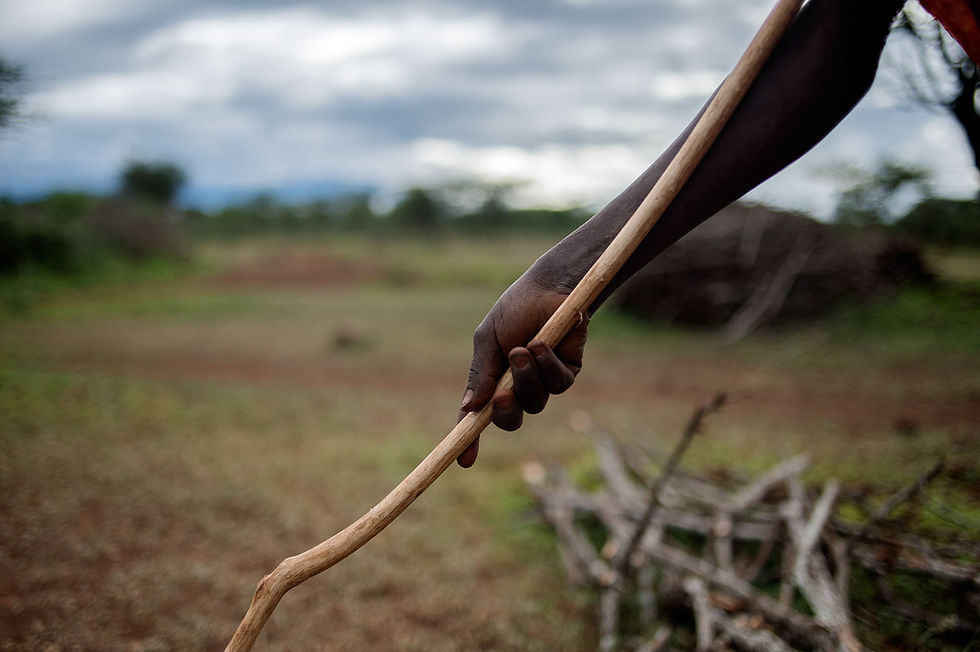
The arm of a young Maasai boy holding a herding stick in the village of Rombo Manyatta, Kenya, on May 10, 2016. In many families, older children take on herding responsibilities, which can limit their ability to attend school, while younger siblings continue their education.
The arm of a young Maasai boy holding a herding stick in the village of Rombo Manyatta, Kenya, on May 10, 2016. In many families, older children take on herding responsibilities, which can limit their ability to attend school, while younger siblings continue their education.

A Maasai woman walks between houses in the village of Rombo Manyatta, Kenya, on May 6, 2016. In the community, women are largely responsible for daily village life, childcare and household management, while men are often away with livestock for long periods.
A Maasai woman walks between houses in the village of Rombo Manyatta, Kenya, on May 6, 2016. In the community, women are largely responsible for daily village life, childcare and household management, while men are often away with livestock for long periods.
I lived for a period of time in the Maasai village of Rombo Manyatta, in southern Kenya, sharing daily life with the community. My presence was quiet and gradual, shaped by observation rather than intervention, allowing moments of everyday life to unfold naturally in front of the camera.
The photographs document ordinary gestures: herding livestock, collecting water, washing clothes at the river, resting in the shade, or moving through the village at night. Livestock plays a central role in the community’s life, shaping both its economy and social structure, while dogs guard the village perimeter after dark, protecting it from wildlife roaming the surrounding savanna.
Education, work, and responsibility intersect early in life. Older children often take on herding duties, while younger siblings are more likely to attend school. Women manage the household and much of the daily organization of village life, while men spend long periods away with the cattle.
This project is not intended as a comprehensive description of Maasai culture, but as a personal visual account of time spent within the community. By focusing on details, routines, and quiet moments, Journey to Maasai Land seeks to reflect the rhythm of everyday life as experienced from within, rather than observed from a distance.

Late afternoon sunlight casts long shadows from the small houses arranged in a circular layout toward the center of the village as a goat passes through near the Maasai village of Rombo Manyatta, Kenya, on May 7, 2016. The village layout reflects traditional settlement patterns of the Maasai community.
Late afternoon sunlight casts long shadows from the small houses arranged in a circular layout toward the center of the village as a goat passes through near the Maasai village of Rombo Manyatta, Kenya, on May 7, 2016. The village layout reflects traditional settlement patterns of the Maasai community.

A dog passes in front of a house in the Maasai village of Rombo Manyatta at night, Kenya, on May 6, 2016. Dogs play an important role in guarding the loosely defined village perimeter from wild animals during nighttime hours.
A dog passes in front of a house in the Maasai village of Rombo Manyatta at night, Kenya, on May 6, 2016. Dogs play an important role in guarding the loosely defined village perimeter from wild animals during nighttime hours.

The interior of a small Maasai house is lit by a single candle at night in the village of Rombo Manyatta, Kenya, on May 6, 2016. The dwelling is modest in size, with a roof opening that allows smoke from indoor fires to escape, and is primarily used for sleeping, while most daily activities take place outdoors.
The interior of a small Maasai house is lit by a single candle at night in the village of Rombo Manyatta, Kenya, on May 6, 2016. The dwelling is modest in size, with a roof opening that allows smoke from indoor fires to escape, and is primarily used for sleeping, while most daily activities take place outdoors.

An elderly Maasai woman cooks outside her home in the village of Rombo Manyatta, Kenya, on May 6, 2016.
An elderly Maasai woman cooks outside her home in the village of Rombo Manyatta, Kenya, on May 6, 2016.

An elderly Maasai man is photographed at night with his eyes closed in the village of Rombo Manyatta, Kenya, on May 11, 2016. He was one of the few people in the community able to speak English, while Maasai and Swahili are predominantly spoken.
An elderly Maasai man is photographed at night with his eyes closed in the village of Rombo Manyatta, Kenya, on May 11, 2016. He was one of the few people in the community able to speak English, while Maasai and Swahili are predominantly spoken.

A close-up of the hands of an elderly Maasai man at night in the village of Rombo Manyatta, Kenya, on May 11, 2016. The image focuses on physical details shaped by age and daily life within the community.
A close-up of the hands of an elderly Maasai man at night in the village of Rombo Manyatta, Kenya, on May 11, 2016. The image focuses on physical details shaped by age and daily life within the community.

After sunset, darkness falls quickly in the Maasai village of Rombo Manyatta, Kenya. With no artificial lighting, evening light comes from scattered fires inside and outside the houses and from the stars, on May 6, 2016.
After sunset, darkness falls quickly in the Maasai village of Rombo Manyatta, Kenya. With no artificial lighting, evening light comes from scattered fires inside and outside the houses and from the stars, on May 6, 2016.

In a nearby village with houses built of brick or wood, a young girl cautiously peers out from the darkness of an adjacent room near the Maasai village of Rombo Manyatta, Kenya, on May 14, 2016. The village contrasts with the traditional mud-built houses of Rombo Manyatta.
In a nearby village with houses built of brick or wood, a young girl cautiously peers out from the darkness of an adjacent room near the Maasai village of Rombo Manyatta, Kenya, on May 14, 2016. The village contrasts with the traditional mud-built houses of Rombo Manyatta.

At night, the darkness and silence of the savanna are briefly interrupted as a man returns to the Maasai village of Rombo Manyatta on a motorcycle, Kenya, on May 6, 2016. Traveling after dark carries serious risks due to elephants roaming the area, which can become aggressive when approached unexpectedly; a fatal incident had occurred only months earlier under similar circumstances.
At night, the darkness and silence of the savanna are briefly interrupted as a man returns to the Maasai village of Rombo Manyatta on a motorcycle, Kenya, on May 6, 2016. Traveling after dark carries serious risks due to elephants roaming the area, which can become aggressive when approached unexpectedly; a fatal incident had occurred only months earlier under similar circumstances.

A young Maasai student listens to her teacher inside the village school in Rombo Manyatta, Kenya, on May 4, 2016. The classroom is lit solely by natural light entering through the doorway and openings in the corrugated metal roof.
A young Maasai student listens to her teacher inside the village school in Rombo Manyatta, Kenya, on May 4, 2016. The classroom is lit solely by natural light entering through the doorway and openings in the corrugated metal roof.
Africa offers an intensity that reveals itself only to those prepared to slow down and listen. Its richness is found not only in vast landscapes and wildlife, but in everyday life: in colors, gestures, smells, and human relationships, particularly far from urban centers.
I first traveled to Africa in 2014, drawn by the great national parks of northern Tanzania. Yet the defining moment of that journey came by chance. Our driver, who was connected to a local village chief, suggested visiting a small Maasai village located inside the Ngorongoro Crater. The visit lasted only a short time, but it left a lasting impression. I was so absorbed by what I was experiencing that I did not even raise my camera.
As we left the village, a clear thought formed: I will return here.
I did not want to approach the Maasai as an observer passing through. My intention was to understand their daily life from within — to experience the savannah not as a visitor, but through proximity and shared time. Back in my country, I began searching for a way to return, fully aware of the difficulty of being accepted as a mzungu, a European photographer, within a traditional community.
My search led me to an interview with Catarina Jimenez, a traveler from Costa Rica who had developed a deep relationship with a Maasai community in Kenya. Through her contribution to the construction of a village school, she had earned trust and respect, and was given the Maasai name Nemeyan. I contacted her, and she immediately supported the project, offering to introduce me to the community during her next visit.
In May 2016, I returned to Africa, traveling to the Maasai village of Rombo Manyatta, Kenya. I was hosted by one of the women of the village and lived in a small mud hut, sharing the rhythms of daily life.
Living within the community allowed me to observe everyday routines and to recognize gradual changes taking place.
Despite the absence of electricity, modern and technological objects are increasingly present, revealing the growing influence of the outside world. The Maasai, an ancient population, continue to navigate a fragile balance between preserving their traditions and adapting to external pressures.
Time in the village felt expanded. Days unfolded outdoors, shaped by natural rhythms rather than clocks. Body and mind gradually adjusted to this pace, rooted in the land.
Through this experience, I became aware of something we have largely lost elsewhere — a sense of connection to time, space, and community that remains deeply embedded in this way of life.
Original raw record taken in the evening, when the children gathered around the bonfires and sang traditional chants.
Last evening in the manyatta. Raw record.

Ritual scars and ornaments of a young Maasai herder in the village of Rombo Manyatta, Kenya, on May 8, 2016. Young men often pay close attention to their appearance, sometimes carrying small mirrors attached to their clothing to adjust their hair or garments while moving through or outside the village.
Ritual scars and ornaments of a young Maasai herder in the village of Rombo Manyatta, Kenya, on May 8, 2016. Young men often pay close attention to their appearance, sometimes carrying small mirrors attached to their clothing to adjust their hair or garments while moving through or outside the village.

A young Maasai man is seen in the bush just outside the village, near Rombo Manyatta, Kenya, on May 14, 2016. He belongs to one of the small Maasai settlements scattered across the surrounding area.
A young Maasai man is seen in the bush just outside the village, near Rombo Manyatta, Kenya, on May 14, 2016. He belongs to one of the small Maasai settlements scattered across the surrounding area.

One of the village dogs near the Maasai village of Rombo Manyatta, Kenya, on May 6, 2016. The dogs are collectively cared for by the community and help guard the village perimeter from wild animals; many bear scars and marks from past encounters.
One of the village dogs near the Maasai village of Rombo Manyatta, Kenya, on May 6, 2016. The dogs are collectively cared for by the community and help guard the village perimeter from wild animals; many bear scars and marks from past encounters.

The village school stands just outside the perimeter of the Maasai village of Rombo Manyatta, Kenya, on May 5, 2016.
The village school stands just outside the perimeter of the Maasai village of Rombo Manyatta, Kenya, on May 5, 2016.

At dawn, a Maasai woman checks the livestock gathered inside the village perimeter after the night near Rombo Manyatta, Kenya, on May 10, 2016. The morning marks the return to daily routines following the night’s watch.
At dawn, a Maasai woman checks the livestock gathered inside the village perimeter after the night near Rombo Manyatta, Kenya, on May 10, 2016. The morning marks the return to daily routines following the night’s watch.